Common Sovereignty is currently in proof of concept stage. Before engaging communities directly, it is conducting a virtual pilot to test Phases 1 and 2 of its methodology using secondary data. The stretch goal is to co-create a viable and scalable community-centered blended finance structure that links a cross-border, community-to-community solution to global markets.
The pilot includes five geographically diverse locations in the Global North and South and draws inspiration from existing global commitments to strengthen economic growth and expand access to decent work in underserved communities. If the pilot yields strong root cause alignment and initial interest from at least three of these communities, Common Sovereignty will seek funding to validate findings through primary data collection. Progression through Phases 3 to 5 will depend on the viability of the blended finance structure and continued traction with local stakeholders, funders, and investors.
In parallel, Common Sovereignty is actively building relationships with organizations interested in advancing this proof of concept. There are several ways for prospective partners, incubators, funders, impact investors, and amplifiers to help.
Common Sovereignty uses a five-phase methodology that supports hard-to-reach communities across developed, emerging, and frontier markets to work together in determining how local assets and catalytic capital can meaningfully finance cross-border, community-to-community (C2C) solutions to shared global challenges.
The methodology itself becomes a living proposal, evolving through co-creation as long as mutual social and financial returns remain viable for communities and investors. Throughout the process, Common Sovereignty acts as the convener and intermediary, with funders supporting early-stage scoping (e.g., through a design-stage grant) that leads to an investable blended finance structure. Evidence generated from the financed solution helps amplifiers and policymakers shape global markets, norms, and commitments that are more responsive to local context and agency.
Below is how Common Sovereignty bridges locally led development and global systems reform, with community-based assets and catalytic capital as the enabling force:
Global shocks like pandemics, conflicts, and recessions threaten the durability of local innovation. Stronger resilience requires cross-border collaboration and financing; however, locally-led development efforts in the Global South and North often operate in silos, understandably treating global governance as an abstract “in the clouds” concept shaped by top-down mandates and political settlements that do not always reflect local realities.
Meanwhile, communities, local governments, and businesses with deep contextual knowledge, especially at the hyperlocal level, lack meaningful access to global markets or the decision-makers shaping the global norms and commitments that affect them directly.
Common Sovereignty breaks through these silos, connecting local actors across contexts to define solutions that ground global norm-setting in real-world evidence of what works at the grassroots.
Common Sovereignty welcomes cooperation with nonprofits, social enterprises, and mission-aligned actors that can support local engagement and offer complementary technical expertise for solution deployment. It also plans to refer issues—and potential solutions—identified through its fieldwork to partners when they fall outside its scope to strengthen convening power and advance a systems approach.
Resource mobilization strategies that align local assets with blended finance tools are core to Common Sovereignty’s methodology. It therefore welcomes collaboration with impact investors interested in co-creating blended finance structures that support this approach.
Common Sovereignty seeks alliances with think tanks, universities, and policy networks that can help analyze and disseminate demand-side evidence to global norm-setters. Early engagement will shape how it structures local solutions to effectively support this process.
While the virtual pilot is self-financed, future phases—i.e., field validation of Phases 1 and 2 and the design of investable solutions—will require external support. Common Sovereignty therefore seeks input from funders on how best to finance its core costs to facilitate these next-stage components.
If the proof of concept shows promise, Common Sovereignty may evolve into a standalone organization or a dedicated practice area within an existing institution. It therefore welcomes support from innovation funds, ecosystem builders, and other organizations interested in incubating its early-stage model for global systems change.
Common Sovereignty is also open to consultancies or project-based roles that leverage its expertise while building trusting relationships with communities that may later participate in its model.
The Common Sovereignty Approach
The Common Sovereignty Approach
From Silos to Solutions:
The Common Sovereignty Fund
How to Get Involved
Impact Investors
Partners
Incubators
Funders
From Silos to Solutions: The Common Sovereignty Fund
Amplifiers
Global shocks like pandemics, conflicts, and recessions threaten the durability of local innovation. Stronger resilience requires cross-border collaboration and financing; however, locally-led development efforts in the Global South and North often operate in silos, understandably treating global governance as an abstract “in the clouds” concept shaped by top-down mandates and political settlements that do not always reflect local realities.
Meanwhile, communities, local governments, and businesses with deep contextual knowledge, especially at the hyperlocal level, lack meaningful access to global markets or the decision-makers shaping the global norms and commitments that affect them directly.
Common Sovereignty breaks through these silos, connecting local actors across contexts to define solutions that ground global norm-setting in real-world evidence of what works at the grassroots.
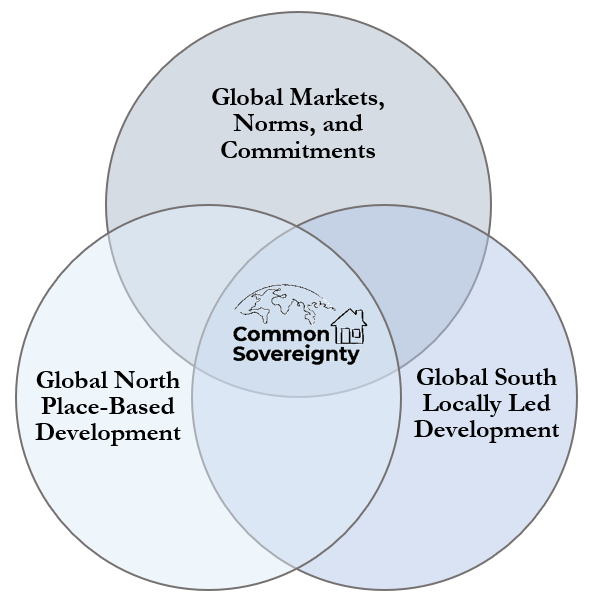
Common Sovereignty uses a five-phase methodology that supports hard-to-reach communities across developed, emerging, and frontier markets to work together in determining how local assets and catalytic capital can meaningfully finance cross-border, community-to-community (C2C) solutions to shared global challenges.
The methodology itself becomes a living proposal, evolving through co-creation as long as mutual social and financial returns remain viable for communities and investors. Throughout the process, Common Sovereignty acts as the convener and intermediary, with funders supporting early-stage scoping (e.g., through a design-stage grant) that leads to an investable blended finance structure. Evidence generated from the financed solution helps amplifiers and policymakers shape global markets, norms, and commitments that are more responsive to local context and agency.
Below is how Common Sovereignty bridges locally led development and global systems reform, with community-based assets and catalytic capital as the enabling force:
How to Get Involved
Common Sovereignty is currently in proof of concept stage. Before engaging communities directly, it is conducting a virtual pilot to test Phases 1 and 2 of its methodology using secondary data. The stretch goal is to co-create a viable and scalable community-centered blended finance structure that links a cross-border, community-to-community solution to global markets.
The pilot includes five geographically diverse locations in the Global North and South and draws inspiration from existing global commitments to strengthen economic growth and expand access to decent work in underserved communities. If the pilot yields strong root cause alignment and initial interest from at least three of these communities, Common Sovereignty will seek funding to validate findings through primary data collection. Progression through Phases 3 to 5 will depend on the viability of the blended finance structure and continued traction with local stakeholders, funders, and investors.
In parallel, Common Sovereignty is actively building relationships with organizations interested in advancing this proof of concept. There are several ways for prospective partners, incubators, funders, impact investors, and amplifiers to help.
Partners
Common Sovereignty welcomes cooperation with nonprofits, social enterprises, and mission-aligned actors that can support local engagement and offer complementary technical expertise for solution deployment. It also plans to refer issues—and potential solutions—identified through its fieldwork to partners when they fall outside its scope to strengthen convening power and advance a systems approach.
Incubators
If the proof of concept shows promise, Common Sovereignty may evolve into a standalone organization or a dedicated practice area within an existing institution. It therefore welcomes support from innovation funds, ecosystem builders, and other organizations interested in incubating its early-stage model for global systems change.
Funders
While the virtual pilot is self-financed, future phases—i.e., field validation of Phases 1 and 2 and the design of investable solutions—will require external support. Common Sovereignty therefore seeks input from funders on how best to finance its core costs to facilitate these next-stage components.
Impact Investors
Resource mobilization strategies that align local assets with blended finance tools are core to Common Sovereignty’s methodology. It therefore welcomes collaboration with impact investors interested in co-creating blended finance structures that support this approach.
Amplifiers
Common Sovereignty seeks alliances with think tanks, universities, and policy networks that can help analyze and disseminate demand-side evidence to global norm-setters. Early engagement will shape how it structures local solutions to effectively support this process.
Common Sovereignty is also open to consultancies or project-based roles that leverage its expertise while building trusting relationships with communities that may later participate in its model.